
Have you ever seen verbs that never tell you when it happens? These are known as non-finite verbs and play a special role in adding some unique spices to our sentences. So, what are they, and how do they work?
What is a Non-Finite Verb?
Non-finite verbs are unique because they do not express tense and do not change form according to the subject. Many times, they function instead as nouns, adjectives, or adverbs. Non-finite verbs have three forms: infinitives (to eat), gerunds (eating), and participles (eaten, eating).
Examples of Non-Finite Verbs:
- Infinitive: “to eat“
- Gerund: “eating“
- Past Participle: “eaten“
- Present Participle: “eating”
Why Are Non-Finite Verbs Important?
Non-finite verbs make our writing colorful since we can express actions but cannot relate those actions to time through time frames. For Example, in the sentence “She loves swimming,” the word “swimming” tells us what “she” enjoys without needing to say when. On the other hand, the verb “loves” is a finite verb that expresses tense and changes itself according to subject and tense.
Identifying Non-Finite Verbs
If you want to find non-finite verbs, recognize that they do not inflect with the subject or with the time:
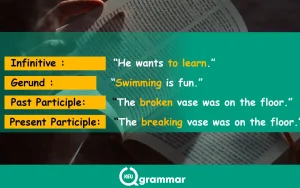
- Infinitive Example: “He wants to learn.”
- Gerund Example: “Swimming is fun.”
- Past Participle Example: “The broken vase was on the floor.”
- Present Participle Example: “The breaking vase was on the floor.”
Real-Life Examples of Non-Finite Verbs
You probably use non-finite verbs all the time in daily conversations:
- At Work: “I plan to finish the report by Friday.” (infinitive)
- In Hobbies: “Reading helps me relax.” (gerund)
- In Descriptions: “The excited crowd cheered.” (Past Participle)
Non-Finite vs. Finite Verbs
The distinction between a finite verb and a non-finite verb is very important. Finite verbs have tense and agree with the subject. On the other hand, Non-finite verbs add value to our sentences with little pieces of action without indicating time. For Example, in the sentence “She likes to dance,” the word “likes” is finite, and “to dance” is non-finite.

Finite Verbs

Non-Finite Verbs

By understanding non-finite verbs, you can enhance your writing, making it more engaging and varied.


