

Do you feel lost when you need to create certain tenses or when you want to ask a question in English? Don’t worry. Auxiliary verbs are your friends that help you with all this. So, let’s look at what they are and what they can do to your writing.
What Are Auxiliary Verbs?
Auxiliary verbs, also known as helping verbs, are the verbs that come before the main verb in the sentence. In “She is running,” the verb “is” helps establish the present continuous tense, which tells the reader that the action is happening in the present.
Why Are Auxiliary Verbs Important in Sentences?
These verbs will help you build many tenses and moods to make your sentences more precise. For instance:
- “He has finished his homework.” Here, “has” indicates that the action is complete.
Common Auxiliary Verbs:
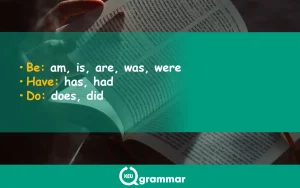
Some of the most frequently used auxiliary verbs include:
- Be: am, is, are, was, were
- Have: has, had
- Do: does, did
Let’s see them in action:
- Be: “They are playing outside.”
- Have: “I have seen that movie.”
- Do: “Do you want to join us?”
How Auxiliary Verbs Change the Meaning of a Sentence
These verbs can also alter the meaning or tone of a sentence. Consider:
- “She can swim.” (shows ability)
- “She could swim.” (indicates past ability)
In this case, “can” and “could” help express different levels of ability.
Auxiliary Verbs in Questions and Negatives
Auxiliary verbs are essential for forming questions and negatives:
- Questions: “Are you coming to the party?” – “Are” is an auxiliary verb.
- Negatives: “I do not like dogs.” – “do” is a negative auxiliary verb.
In both examples, auxiliary verbs ensure that the sentences are structured correctly.
A Quick Guide to Identifying Auxiliary Verbs
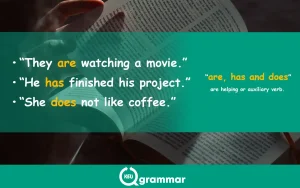
Finding auxiliary verbs is simple; look for them before the main verb. Let’s practice with a few examples:
- “They are watching a movie.”
- “He has finished his project.”
- “She does not like coffee.”
In these sentences, “are,” “has,” and “does” serve as auxiliary verbs.
Making Your Writing Clearer with Auxiliary Verbs
Using auxiliary verbs can enhance your writing and make your writing more effective. For example, Instead of saying, “He runs fast,” you could say, “He is running fast.” In this case, the auxiliary or helping verb “is” helped transform the present simple sentence into the present continuous sentence.


